


Spaccanapoli: history and secrets of the street that divides Naples in two
There is a street in Naples that is not just a street. It is a journey through time, a perfect cut that divides the city into two hemispheres and tells 2,500 years of history. Spaccanapoli — whose name says it all — is the pulsating artery of the historic centre, where every stone has a story to tell and every corner hides a secret. If you look at the city from above, from San Martino or from the Vomero hill, you can see it clearly: a straight line cutting through Naples from east to west, following the route of the ancient Greco-Roman road. But Spaccanapoli is not only ancient history. It is everyday life, craftsmanship, faith, contradiction, beauty and chaos in perfect Neapolitan balance. Whether you are here for a quick weekend or to discover the true soul of the city, walking Spaccanapoli is an experience you will never forget. Here is what you need to know.
The origins: from Neapolis to today
Spaccanapoli follows the lower decumanus of the ancient Greco-Roman city of Neapolis. As far back as 2,500 years ago this road crossed the city from one end to the other, and its route has remained virtually unchanged ever since. A perfectly straight line in a city that seems born from chaos. The popular name “Spaccanapoli” comes precisely from this characteristic: seen from above, the street appears to literally split the city in two. In reality, Spaccanapoli is not a single road but a succession of streets that change name — Via Benedetto Croce, Via San Biagio dei Librai, Via Vicaria Vecchia. But for the Neapolitans it is simply Spaccanapoli, and that is enough. Walking along this street means crossing layer upon layer of overlapping history: Baroque churches built over Roman temples, noble palaces that incorporate Greek walls, artisan workshops in ancient medieval bassi.
The Baroque churches: an open-air museum
Spaccanapoli is home to one of the highest concentrations of Baroque churches in the world. Every hundred metres you come across an architectural masterpiece.
Gesù Nuovo is the first you encounter coming from Piazza del Gesù: its exterior façade in diamond-point rustication is unique in the world, while the interior is a triumph of polychrome marbles, frescoes and gilded decorations. Here you breathe Neapolitan Baroque in all its opulence.
Santa Chiara, with its majolica-tiled cloister, is an oasis of peace and beauty. The eighteenth-century majolicas by Donato and Giuseppe Massa depict scenes of everyday life and bucolic landscapes, creating one of the most photographed places in Naples.
San Domenico Maggiore houses inside it the coffins of the Aragonese nobility and works by Caravaggio. The square in front, with the guglia di San Domenico at its centre, is one of the most elegant views in the historic centre. Do not forget to step inside: many of these churches are free to enter, and the experience of admiring these Baroque masterpieces up close is worth every step.
Hidden secrets: what tourists never see
Spaccanapoli has two levels: the visible one, made up of monumental churches and noble palaces, and the secret one, hidden in the side alleyways and internal courtyards.
Hidden courtyards: Many apparently anonymous doorways open onto splendid Renaissance courtyards. Palazzo Carafa di Montorio, Palazzo Venezia, Palazzo Marigliano — if you find the gates open, go in: they are public spaces and are often completely deserted.
The Veiled Christ: Just a few steps from Spaccanapoli, in the Sansevero Chapel, you will find one of the most incredible sculptures in the world. Christ covered by a marble veil so thin it seems like real fabric. Book in advance, but absolutely not to be missed.
The artisan workshops: Between Via San Gregorio Armeno (the street of the nativity scenes) and Via San Biagio dei Librai there are still workshops where craftsmen work as they did 300 years ago: lute makers, framers, goldsmiths, papier-mâché artists.
The Neapolitan bassi: The street-level dwellings with the door always open onto the road. Here people cook, eat, argue and make up — all in public. It is the theatre of everyday Neapolitan life.
Via San Gregorio Armeno: the street of the nativity scenes
An essential detour from Spaccanapoli is Via San Gregorio Armeno, world-famous for its artisan nativity scene workshops.
Here the Neapolitan art of the presepe is passed down from generation to generation. It is not only religious figurines that are sold: you will find contemporary characters, politicians, actors and footballers. The Neapolitan nativity scene is satire, folklore, current affairs and tradition all at once.
The best time to visit is obviously before Christmas, when the workshops are in full production and the atmosphere is magical. But the rest of the year is worth it too: many craftsmen work year-round and are happy to share the secrets of their trade.
The convent of San Gregorio Armeno, from which the street takes its name, deserves a visit: the Baroque cloister is a hidden gem, and it also houses a permanent monumental nativity scene.
Where to eat along Spaccanapoli
Walking along Spaccanapoli makes you hungry. Fortunately, the options are plentiful.
→ For quick street food: Stop at Friggitiello in Via Tribunali (just above Spaccanapoli) for cuoppi of fried food, arancini and chips. Or try the fried pizza at Di Matteo or Sorbillo — less touristy than its famous sibling but just as good.
→ For a traditional lunch: Tandem in Via Paladino serves the best Neapolitan ragù in the historic centre. Nennella in the Spanish Quarters (5 minutes on foot) is an authentic experience: chaotic, unpretentious, affordable and unforgettable.
→ For a historic coffee: Bar Nilo has the Maradona statue and excellent coffee. Scaturchio in Piazza San Domenico Maggiore serves the best babà and sfogliatelle in the centre.
→ For aperitivo: The squares along Spaccanapoli (Piazza Bellini, Piazza San Domenico Maggiore) fill up with outdoor tables from 18:00. The Neapolitan aperitivo is not the Milanese buffet — it is a moment of genuine sociality.
Practical tips for visiting Spaccanapoli
When to go: Early morning (8:00–10:00) to avoid the crowds and watch the shops opening, the Neapolitans doing their shopping, the city waking up. Or late afternoon (17:00–19:00) when the light is magical and the atmosphere grows more relaxed.
How to get around: On foot. It is the only way. Spaccanapoli is pedestrianised in some stretches, but even where cars pass, walking is the only sensible option. The distances are short: from one end to the other is roughly 2 km.
What to bring: Comfortable shoes (the sampietrini cobblestones are uneven), a bottle of water (it gets very hot in summer), a camera, and an open mind.
How much time you need: Half a day for a relaxed walk with stops at the main churches. A full day if you also want to visit the museums (Sansevero Chapel, Santa Chiara) and take your time over a meal.
Conclusion: the soul of Naples in one street
Spaccanapoli is not just a street to walk down. It is the very essence of Naples: layered, contradictory, chaotic and beautiful. Here the sacred and the profane mingle, the past and the present coexist without conflict, artistic beauty sits alongside the most authentic everyday life.
Do not try to understand it all at once. Let yourself be carried along, lose your bearings in the side alleys, step into the churches, taste the street food, sit down in a square and watch. Spaccanapoli reveals itself slowly, to those who have the patience to listen.
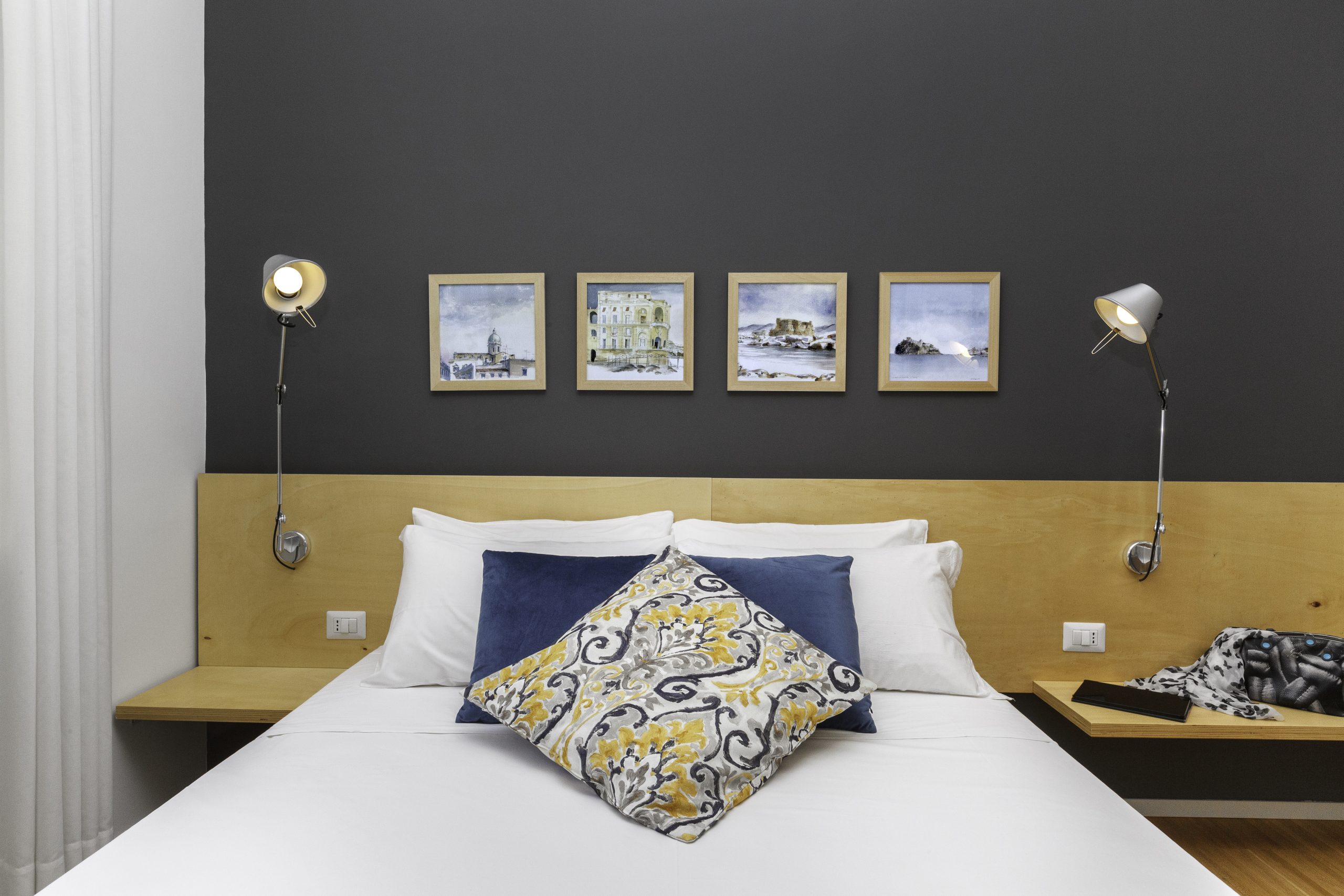
Live in the most elegant neighbourhood in Naples
Vivaldo Suite Piazza dei Martiri: three minimal rooms in the heart of refined Naples. Just steps away from boutiques, historic cafés and the waterfront. A strategic position between Chiaia and the historic centre.
VIVALDO SUITE
INFORMATIONS
Vivaldo Suite by Essebi srl
Registered Office: Viale A. Gramsci, 21
80122 Naples
VAT: 04315861213
Tel/WhatsApp: +39 388.9569244