


Spaccanapoli: the complete guide to Naples’ ancient heart
There are streets you don’t just pass through — you inhabit them. Spaccanapoli is one of those. A straight line, nearly two kilometres long, slicing through Naples from one side to the other like a blade — and managing, in this narrow, noisy, magnificent space, to hold two thousand years of history, baroque art, nativity scenes, fried pizza, votive shrines and an amount of everyday life you’d be hard pressed to find anywhere else on earth, all in one place.
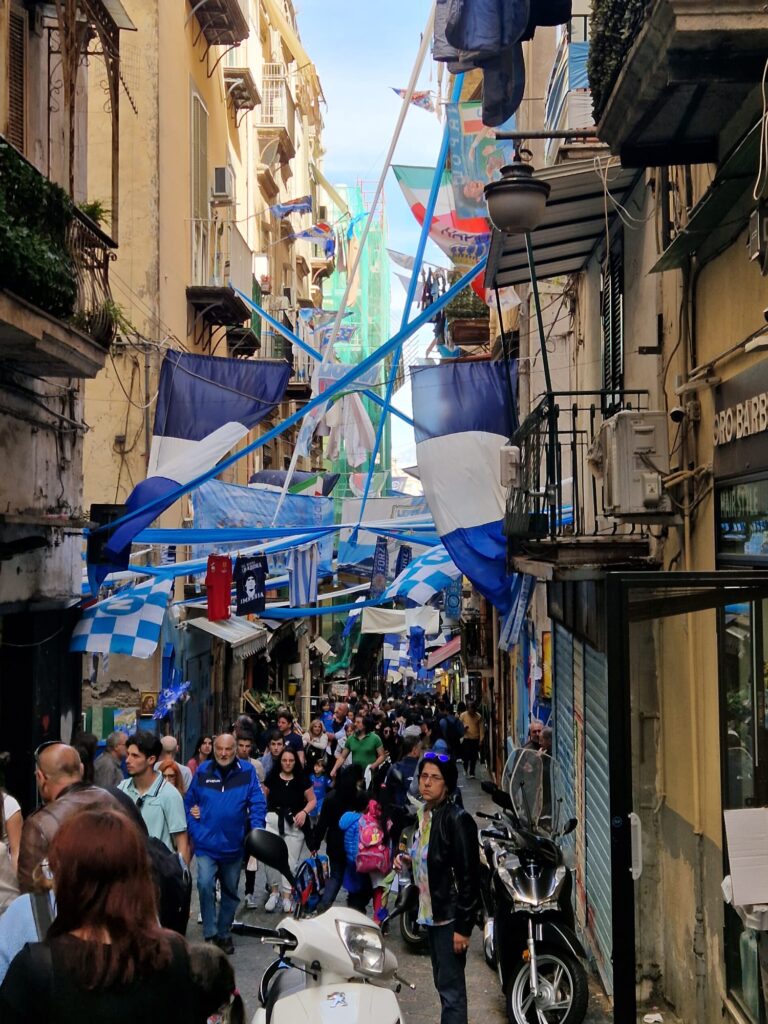
You can’t claim to truly know Naples without having explored this one-of-a-kind axis. The shouts of street vendors and students, laundry drying in sunny alleyways, the smell of pizza and coffee, the colours of nativity figures and ceramics spilling out of artisan workshops: Spaccanapoli is not a street, it is an experience.
Whether you’re here for a weekend or a week, this guide to what to see in Spaccanapoli will walk you through every stretch of this historic axis, stop by stop, flavour by flavour.
A brief history
Before you start walking, it’s worth understanding where you’re putting your feet. Spaccanapoli didn’t originate in the Middle Ages or the Baroque period — it goes back much further, to a time when Naples was still called Neapolis and was a Greek city.
Spaccanapoli is not the official name of a single street but the collective name Neapolitans use for the long axis running through the city from west to east. The route is made up of Via Pasquale Scura, Via Maddaloni, Via Benedetto Croce, Via San Biagio dei Librai, Via Vicaria Vecchia, Via Forcella and Via Giudecca Vecchia. In roughly two kilometres it contains a concentration of history, art and daily life that is hard to match anywhere else in Europe.
Spaccanapoli follows the lower decumanus of ancient Greek Neapolis, founded around the fifth century BC. The route originally stretched from Piazza San Domenico to Via Duomo; in Roman times it was extended to the area of what is now Piazza del Gesù Nuovo, as evidenced by the remains of Roman baths discovered beneath the Cloister of Santa Chiara.
During the Renaissance the street was transformed significantly: Gothic structures were remodelled and new buildings rose in place of demolished palazzi, thanks to architects such as Giovanni Francesco Mormando and Giovanni Francesco di Palma. In the sixteenth century, Viceroy Don Pedro de Toledo promoted the city’s expansion towards the hill of San Martino, aligning the lower decumanus with the Quartieri Spagnoli. Between the seventeenth and eighteenth centuries religious and private buildings were further remodelled, and in the nineteenth century several palazzi were restored to their original forms.
In 1995 the entire historic centre of Naples — with Spaccanapoli as its backbone — was inscribed on the UNESCO World Heritage List with the citation: “Naples is one of the oldest cities in Europe, whose contemporary urban fabric preserves the elements of its long and significant history.”
What to see in Spaccanapoli: the essential stops
Walking along Spaccanapoli is like passing through an open-air museum — except here nobody asks for a ticket and real people actually live here. These are the stops you cannot miss.
Piazza del Gesù Nuovo
Piazza del Gesù Nuovo is one of the most important and lively squares in Naples: the ideal starting point for anyone walking Spaccanapoli from the west. It takes its name from the church of the same name, one of the finest examples of Renaissance architecture in the city, whose façade actually belongs to the Palazzo Sanseverino on which the church was built. Legend has it that the markings visible on the dark volcanic stone (piperno) are esoteric symbols carved in reverse to curse the building. At the centre of the square rises the Guglia dell’Immacolata, a typically extravagant Neapolitan Baroque spire.
The monumental complex of Santa Chiara
One of the most significant things to see in Spaccanapoli. It all began at the end of the fourteenth century, when Queen Sancia of Majorca — having been unable to enter a cloistered convent herself — asked her husband Robert of Anjou to build her a religious complex. The king did not hesitate, and bequeathed to us this extraordinary treasure chest of art. The complex comprises a monastery, a church and a convent, but its true jewel is the Cloister of the Poor Clares (Chiostro delle Clarisse), transformed in the eighteenth century by Domenico Antonio Vaccaro and decorated with vivid majolica tiles by Giuseppe and Donato Massa.
Piazza San Domenico Maggiore
With its open-air cafés and the noble palazzi surrounding it — including Palazzo Petrucci and Palazzo Sangro di Casacalenda — Piazza San Domenico Maggiore is one of the most vibrant squares in Naples. It is dominated by the polygonal apse of the church of the same name which, together with the adjacent convent complex, forms one of the most significant treasures of the historic centre. The focal point is the eighteenth-century Guglia di San Domenico, erected as an act of gratitude to the saint for having delivered the city from plague in 1656.
Cappella Sansevero
One block off the main axis, along Via Francesco De Sanctis, lies one of the most extraordinary monuments in Naples. The Cappella Sansevero is the funerary chapel of the di Sangro family: according to legend it was built at the end of the sixteenth century on the spot where a man reportedly had a vision of the Madonna. Restructured and decorated in the Baroque style in the eighteenth century, it houses priceless masterpieces, including the celebrated marble sculpture by Giuseppe Sanmartino depicting the body of Christ covered by a veil so realistically rendered it seems made of real fabric. Booking in advance is strongly recommended.
Piazzetta Nilo
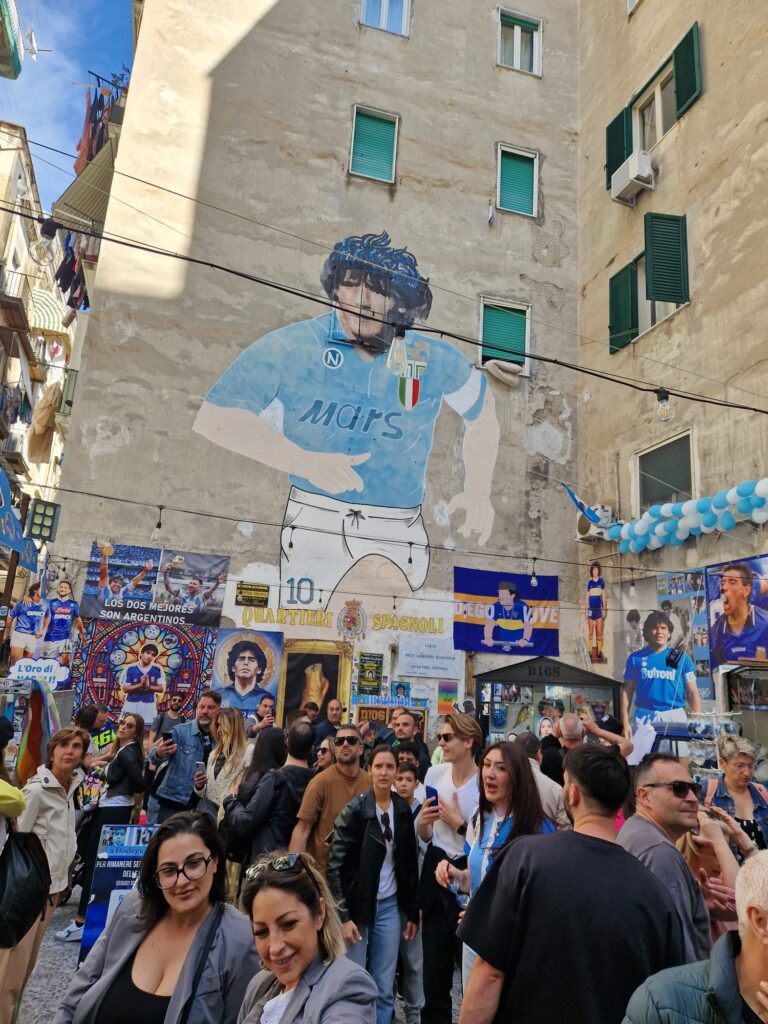
A few steps from Piazza San Domenico, you come upon the evocative Piazzetta Nilo, overlooked by the Baroque church of Sant’Angelo a Nilo. Here you will encounter two deities. The first is the Statue of the River Nile, erected by Alexandrian merchants in Roman times, depicting the ancient Egyptian god as a bearded, semi-nude old man reclining on the waves of the river. The second — inside Bar Nilo — is the small shrine dedicated to Diego Maradona, a most fervently venerated local divinity.
Via San Biagio dei Librai
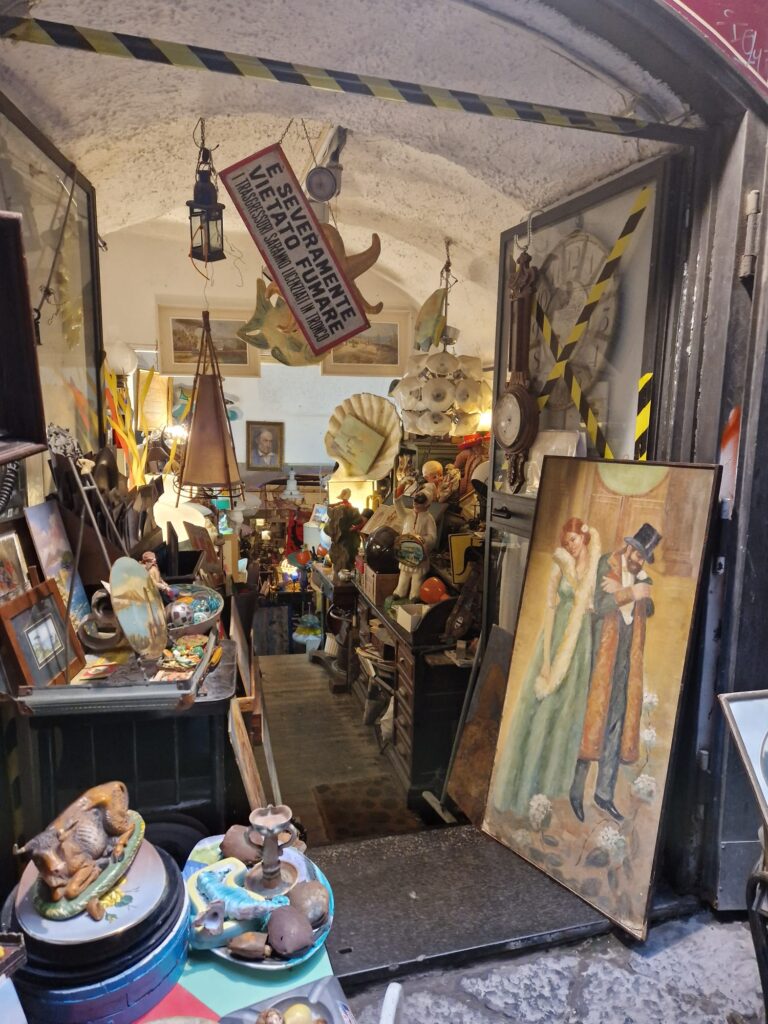
This stretch is perhaps the densest and most visceral of all Spaccanapoli. Once lined with bookshops — as its name suggests — it is today the street of Neapolitan craftsmanship: objects in ceramic, wood, feather and glass spill out of every doorway. Along the street stand several significant Renaissance palazzi, including the Palazzo del Monte di Pietà, Palazzo Marigliano and Palazzo Carafa Santangelo, as well as the small church of San Biagio Maggiore, well worth a visit.
Via San Gregorio Armeno
A mandatory detour. Via San Gregorio Armeno is the cardo connecting the lower decumanus to the upper one and is one of the most famous and visited streets in Naples. On this alley it is always Christmas: the artisan workshops producing Neapolitan nativity scenes (presepi), open all year round, have been selling figurines of every kind for generations — from the traditional little donkeys to irreverent caricatures of contemporary celebrities. The street also houses the church of San Gregorio Armeno, with its beautiful cloister.
What and where to eat in Spaccanapoli
Walking along Spaccanapoli without stopping to eat at least three or four times would almost be a sin. Neapolitan street food is widely considered among the best in the world, and this stretch of city is its undisputed capital.
It is impossible not to begin with pizza fritta: born after the Second World War as a hearty, affordable alternative to oven-baked pizza, it has become an institution over time. It was in those difficult postwar years that the Neapolitan art of making do produced one of its finest creations. Where to eat it? At Antica Pizzeria De’ Figliole, at Via Giudecca Vecchia 39: a true institution.
Equally unmissable is the pizza a portafoglio (folded pizza): a margherita or marinara, slightly smaller than the classic, with a thinner crust, folded in four (hence the name “a libretto”, meaning “like a little book”) and served straight from the oven in a paper wrap. Practical, affordable and utterly delicious — the perfect solution for anyone exploring the city on foot. Among the best spots is the historic Antica Pizzeria Di Matteo, at Via dei Tribunali 94, which runs parallel to Spaccanapoli.
Then there is the cuoppo: a cone of straw paper filled with fried morsels, available in two versions — land (potato croquettes, arancini, pasta frittata, zeppoline dough balls, battered vegetables) and sea (anchovies, salt cod, seafood zeppoline, baby squid). It is the world’s oldest fast food, but with considerably more soul. Worth trying at Il Cuoppo, at Via San Biagio dei Librai 23.
For a sweet break, two things are non-negotiable: the sfogliatella — in the riccia version (flaky, crispy pastry) or the frolla (softer and more buttery), both filled with ricotta, semolina, candied fruit and cinnamon, best eaten warm straight from the oven — and the babà, which needs no introduction. For both, a compulsory stop is the historic Pasticceria Scaturchio in Piazza San Domenico Maggiore, in business since 1905.
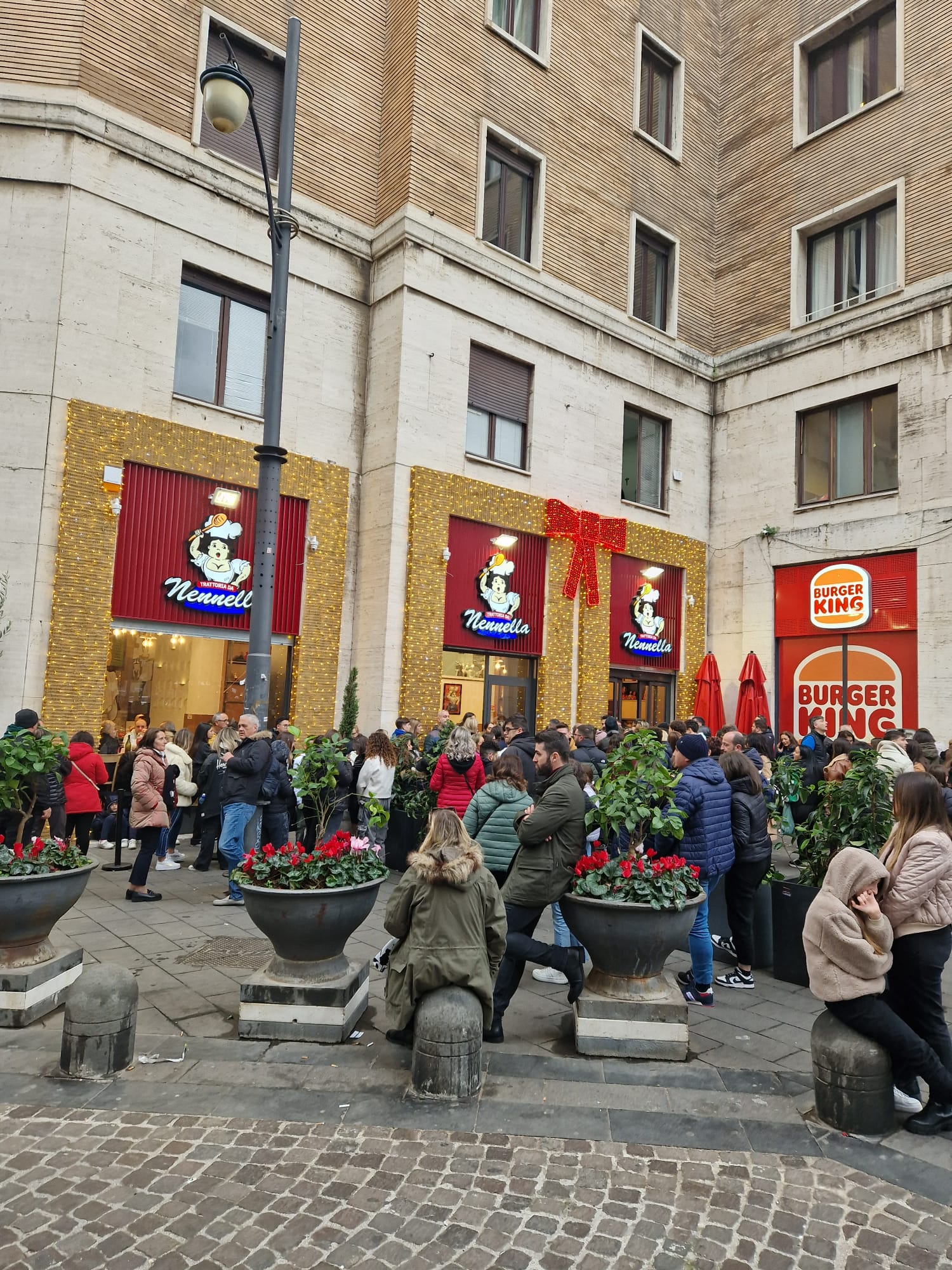
If you prefer to sit down, numerous trattorie serving authentic Neapolitan cooking at honest prices line Spaccanapoli and the surrounding alleyways. Among those we recommend: Tandem, at Via Benedetto Croce 48, which serves the finest Neapolitan ragù in the historic centre; and Trattoria da Nennella, at Piazza Carità, famous for its generous traditional dishes and its wonderfully theatrical atmosphere.
Spaccanapoli: a place you never forget
Two kilometres. Just two kilometres to cross two thousand years of history, shift atmosphere five times, eat three different things and come home with the feeling of having witnessed something unrepeatable. Spaccanapoli is not one stop on a Naples itinerary — it is Naples, distilled into its purest form.
Walking it once is never enough. It changes character according to the time of day, the day of the week, the season. Early in the morning, when market stalls open and bars begin roasting coffee, it is one thing. In the evening, when the alleys fill with life and the light from workshop windows glows on the ancient stone, it is quite another.
If you want to truly understand Naples — not just visit it — Spaccanapoli is the right place to start. And if you’re planning your stay, our guide Naples in 48 hours gives you the complete itinerary to make sure you miss nothing in the city.
Frequently asked questions about Spaccanapoli
What exactly is Spaccanapoli?
Spaccanapoli is not the name of a single street but the collective name Neapolitans use for the long axis running through the historic centre of Naples from west to east, made up of seven different streets. The name literally means “split Naples”, and it’s easy to see why: viewed from above, this axis cuts through the city with almost geometric precision. It has been a UNESCO World Heritage Site since 1995.
How long does it take to visit Spaccanapoli?
For a thorough visit — taking in the main churches, the Cappella Sansevero, Via San Gregorio Armeno and a few food stops — allow at least half a day, ideally a full day. If you also want to visit museums (Pio Monte della Misericordia, Museo Madre) or browse artisan workshops, add several more hours. Early morning is the best time to start: fewer people and ideal light for photographs.
Is Spaccanapoli safe?
Yes. Spaccanapoli is one of the most visited and well-frequented areas of Naples, walked every day by thousands of tourists and residents. As in any busy European historic centre, it is wise to keep an eye on your belongings, avoid displaying valuables and stick to the main routes at night. With normal precautions, it is an absolutely safe and vibrant place to be. If you’re planning a full day in the city, our guide [LINK 1: Naples in 48 hours] helps you structure your time to make the most of it.
How do you get to Spaccanapoli?
The most convenient western entry point is Piazza del Gesù Nuovo, reachable on foot from Via Toledo or from the Dante metro station (Line 1). From the east you can arrive from Piazza del Municipio or from the Central Station via metro to Piazza Cavour. Once on the street, you move almost entirely on foot: the lanes are too narrow for vehicles.
Is it worth staying near Spaccanapoli?
Absolutely. Staying in the historic centre means waking up already in the heart of Naples, setting off on foot to explore the stops in this guide and experiencing the city at a completely different rhythm from those staying on the outskirts. Our Vivaldo Suite Spaccanapoli is located at Vico SS. Filippo e Giacomo 26, just steps from Via San Biagio dei Librai and Via San Gregorio Armeno: an ideal base from which to explore the entire historic centre. If you prefer the elegant Chiaia neighbourhood, Vivaldo Suite Piazza dei Martiri is the perfect starting point for day two of your itinerary.
