


Naples and beyond: Pompeii, Herculaneum and the Phlegraean Fields in a day
Naples is a city that never stops surprising, but some of its most fascinating places lie well beyond the city limits. Just a short distance from the centre, within a few dozen kilometres, stretches a historical and natural heritage that is truly unique in the world. We are talking about Pompeii, Herculaneum and the Phlegraean Fields: three sites of extraordinary beauty, capable of telling centuries of history, myths and legends.
Between culture, nature and atmosphere, Naples and its surroundings represent an ideal destination for anyone who wants to live an intense and complete experience even in a short time, allowing themselves to be won over by one of the richest and most varied territories in Italy.
Is it possible to visit all three sites in a single day? Yes, with a well-organised itinerary. In this guide we suggest an optimised route to make the most of these wonders, without missing what makes them truly unforgettable. It won’t be an in-depth visit, but an intense journey that will stay with you.
First Stop – Pompeii
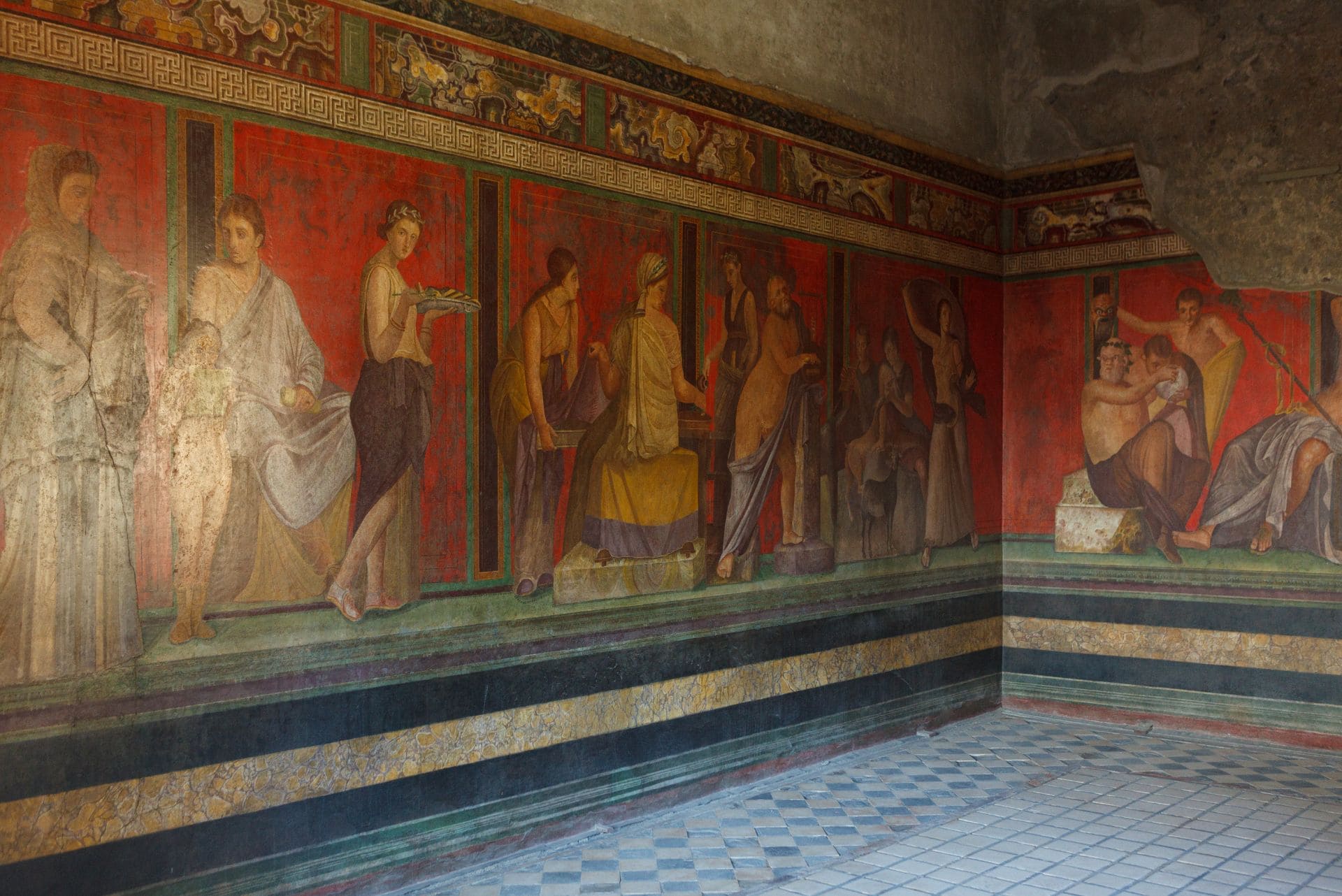
Starting with Pompeii means choosing the most extensive and iconic site in the Vesuvian area — the first essential stop for anyone who wants to take a day trip from Naples and carry the memory of it for a lifetime. An Oscan city, then Samnite and finally Roman, Pompeii enjoyed centuries of prosperity as an important commercial centre and aristocratic holiday retreat. In 63 AD a violent earthquake largely destroyed it, and sixteen years later the eruption of Vesuvius only worsened an already critical situation. Yet it was precisely that volcanic catastrophe that made it immortal: the ash and lapilli ensured its exceptional preservation, offering a vivid picture of daily life in Roman cities.
Archaeological excavations, begun in the eighteenth century and still ongoing, have progressively brought to light much of the city, with public buildings, homes, shops and artistic treasures of extraordinary value. Walking along the ancient paved streets, it becomes immediately clear why Pompeii is one of the most important archaeological sites in the world.
What to see in Pompeii
Three hours are not enough to see everything, but they are sufficient to grasp the essence of the city. Here are the unmissable stops, each one capable of telling a different story about the Pompeii that once was.
House of the Faun. One of the most luxurious residences in the ancient city, named after the small bronze statuette of a dancing faun placed at the centre of the main impluvium pool (today replaced by a copy).
House of the Vettii. Famous for its wonderful array of wall decorations, mainly paintings in the fourth Pompeian style.
Garden of the Fugitives. Home to the plaster casts of some of the eruption’s victims, caught as they attempted to flee. One of the most moving images in the entire site.
Lupanar. The most important brothel in Pompeii, decorated with erotic paintings. A direct and unfiltered testament to Roman daily life.
Temple of Apollo. One of the oldest places of worship in the city, with origins dating back to the sixth century BC.
Villa of the Mysteries. An enormous building that takes its name from the magnificent frescoes in the triclinium, depicting the initiation rites of the cult of Dionysus. A work of rare beauty and evocative power.
Second stop — Herculaneum
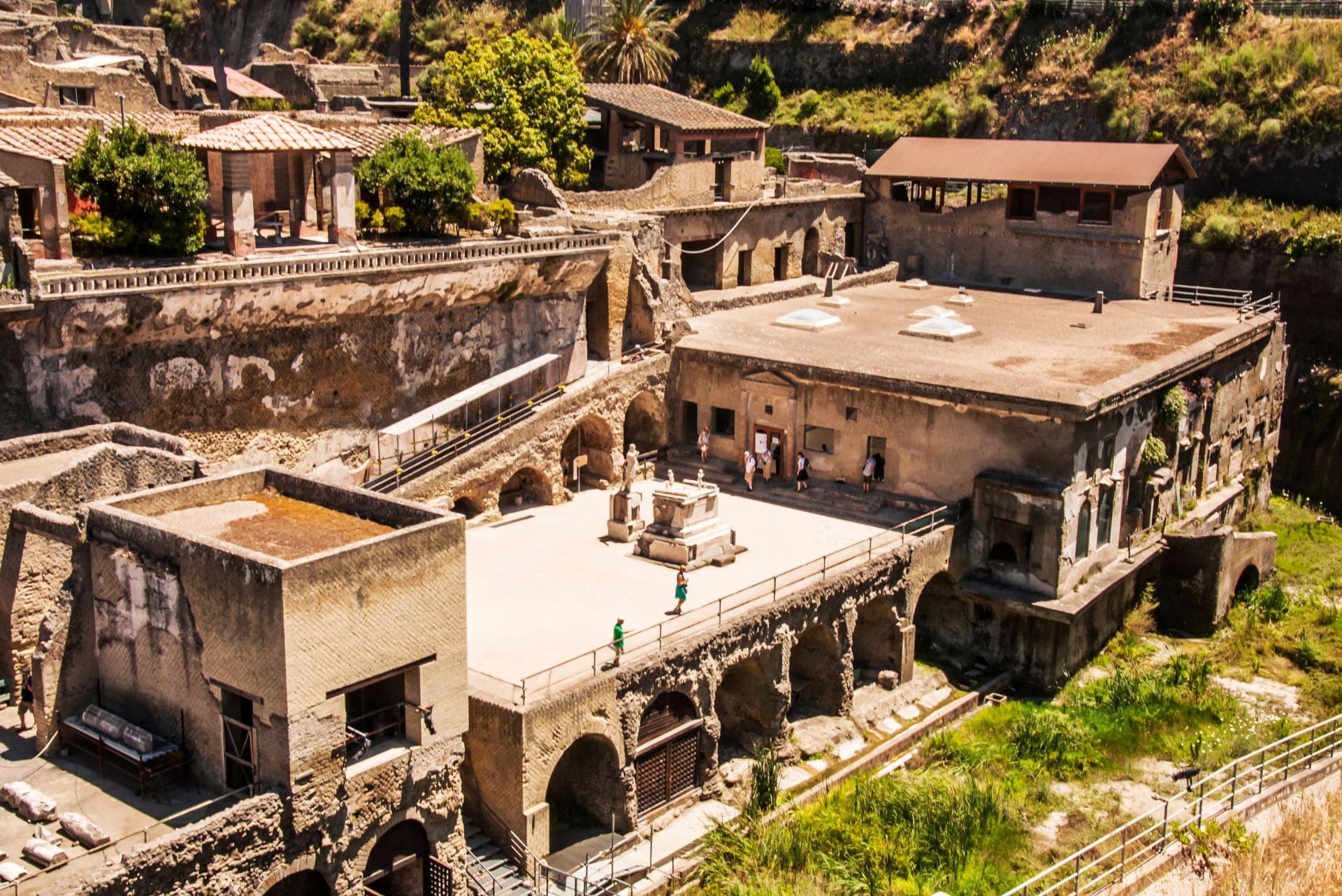
A few kilometres from Pompeii, Herculaneum is the stop that surprises even the most well-informed visitors: more compact, more intimate, yet in some respects even better preserved than its more famous neighbour. Founded, according to legend, by Hercules in 1243 BC, it too was buried by the eruption of Vesuvius in 79 AD. But unlike Pompeii, it was covered by a thick layer of mud and pyroclastic material that preserved buildings, objects, furnishings and even organic materials in a remarkable way.
As the celebrated archaeologist Amedeo Maiuri noted, Herculaneum should be considered “a city and not a mine of works of art, a smaller and different city from Pompeii, but no less important for that, with its urban character, its civilisation and, most importantly, its human face.” Excavation campaigns, begun in 1738, have uncovered only a quarter of the 20 hectares the city once occupied. And yet there is no shortage of things to see.
What to see in Herculaneum
A couple of hours are enough to grasp the essence of the site, provided the stops are chosen well. Herculaneum rewards those who take the time to look at the details.
House of the Deer. One of the most spectacular townhouses, named after two sculptures of deer attacked by dogs placed in the garden.
House of Neptune and Amphitrite. Home to a splendid glass paste mosaic in the triclinium, depicting the sea god and his wife in all their decorative splendour.
Samnite House. Striking for its beautiful Hellenistic-style atrium, decorated with fourth-style paintings.
Suburban Baths. The best-preserved Roman thermal complex to have survived to the present day — a precious testimony to the organisation of public life in the ancient city.
Seat of the Augustales. A representative building with walls enriched by elegant paintings.
Villa of the Papyri. One of the largest and most sumptuous Roman villas ever explored, in which more than 1,800 carbonised papyrus scrolls were discovered. Much of the villa still lies beneath the ground.
Third stop — the Phlegraean Fields
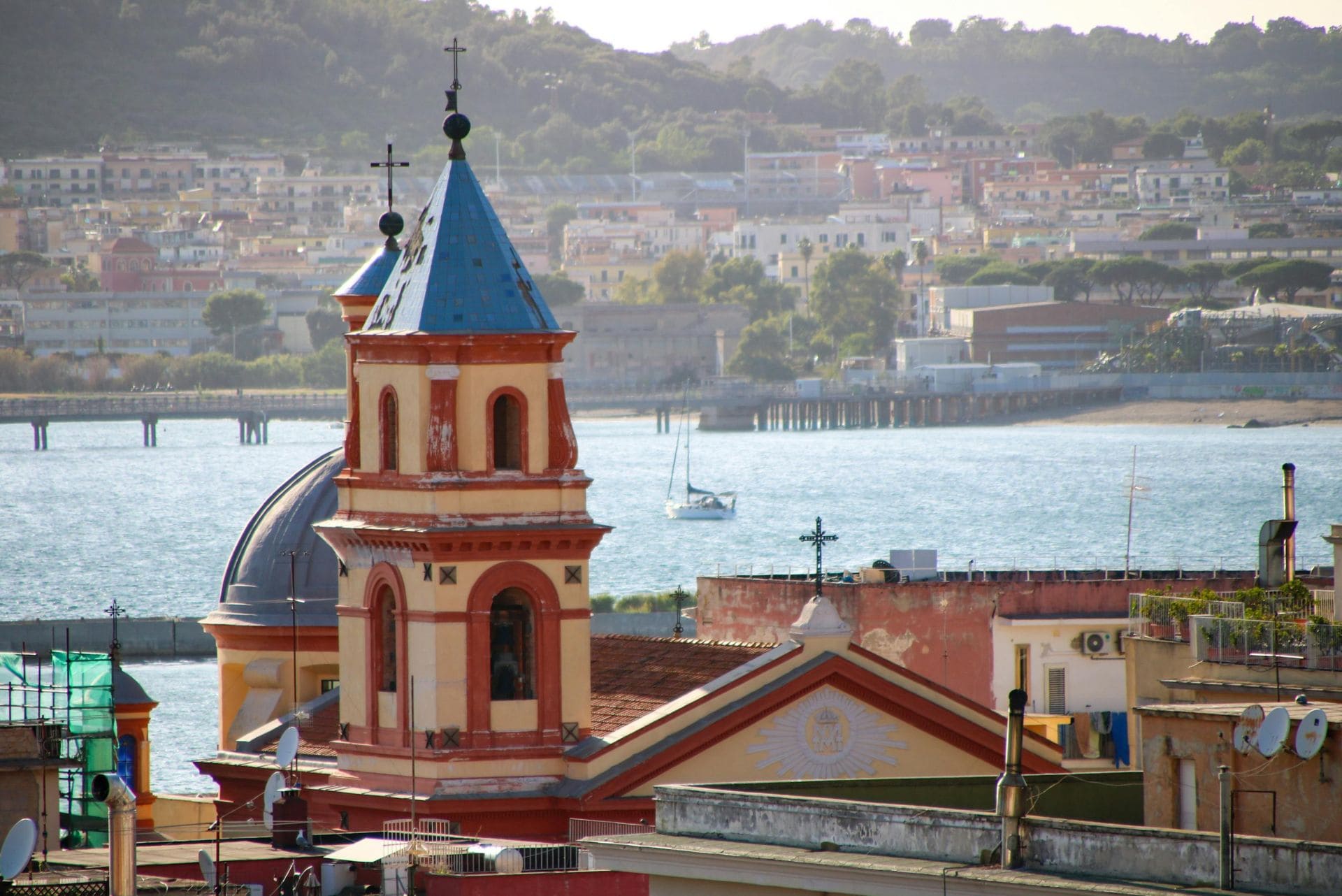
In the afternoon the landscape changes radically, and with it the atmosphere. The Phlegraean Fields are an active volcanic area situated to the west of Naples, where nature, archaeology and myth intertwine in a way that has no equal in Italy. This is not a classic cone-shaped volcano: the Phlegraean Fields are a caldera, a large flat-bottomed basin formed by explosive eruptions. The area is characterised by fumaroles and a phenomenon of slow ground deformation — bradyseism — which over the centuries has altered even the coastline.
The myths sung by Homer and Virgil, the legacy of Greek culture that spread from these lands across the entire peninsula, and the traces left by the Roman aristocracy who built their luxurious residences here: all of this adds to the fascination of a territory where natural beauty and human ingenuity merge into a truly unparalleled setting. A day trip from Naples that is worth the journey on its own.
What to see in the Phlegraean Fields
The area is vast: for an afternoon visit, it is best to select two or three of the most representative stops, without attempting to cover everything.
Solfatara di Pozzuoli. An ancient volcanic crater known for its intense emissions of sulphurous vapours and the evocative geothermal phenomena visible at the surface. A landscape that seems to belong to another planet.
Rione Terra. The oldest urban nucleus of Pozzuoli, inhabited since the second century BC. Walking its streets means retracing two thousand years of history in just a few steps.
Lake Avernus. Associated in the Greek and Roman imagination with the entrance to the underworld, this volcanic lake still exerts a dark and powerful fascination today.
Archaeological Park of Cumae. Enclosing monumental remains of extraordinary importance, most notably the celebrated Cave of the Cumaean Sibyl: a gallery carved into the tuff where, according to tradition, the prophetess delivered her oracles.
Practical tips for making the most of the day
Visiting Pompeii, Herculaneum and the Phlegraean Fields in a single day requires planning, but it is entirely feasible. The secret is not to try to see everything, but to carefully choose the priority stops at each site, accepting that a day trip of this kind from Naples offers a rich overview rather than an exhaustive one. The right pace transforms an intense day into a truly memorable experience.
Suggested itinerary
8:00 am — Departure from Naples towards Pompeii, best visited in the cooler morning hours. Three hours cover the main highlights.
12:30 pm — Transfer to Herculaneum, with a visit of around two hours.
3:30 pm — Return towards Naples with a detour to the Phlegraean Fields, selecting one or two of the main stops suggested above.
Getting there
The fastest and most flexible option is by car. However, it is also possible to organise the day using public transport: the Circumvesuviana connects Naples (Garibaldi Station) with Pompeii and Herculaneum, while the Phlegraean Fields can be reached by Metro Line 2 from Piazza Garibaldi, or by train from Portici-Ercolano Station. Bear in mind that journey times by public transport are longer and require more careful management of timetables.
Opening hours and tickets
The sites have variable opening hours — generally from 9:00 am to 7:00 pm — so it is always best to check the official website before your visit. Buying tickets online in advance is strongly recommended, especially in the summer months when queues can be very long. It is also worth looking into any combined tickets or tourist passes available for the Vesuvian and Phlegraean areas.
What to bring
Comfortable shoes are essential: cobblestones and paved streets take a toll on your feet even during short walks. Plenty of water, especially in summer, when the limited shade and high temperatures make visits demanding. A hat and sunscreen, since the sites are largely open-air. And finally, an audio guide or printed guide — especially at Pompeii — because having support transforms the experience entirely, adding stories and context that would otherwise be missed.
Frequently asked questions about Naples and its surroundings
Is it possible to visit Pompeii, Herculaneum and the Phlegraean Fields in a single day? Yes, with a well-planned itinerary it is possible. The secret is to choose the priority stops at each site: around three hours at Pompeii, two at Herculaneum and the afternoon at the Phlegraean Fields. It won’t be an in-depth visit, but it will be an intense and unforgettable experience. Those with more days available can dedicate a full day to each site.
