


Pompeii from Sorrento: how to plan a one-day visit
A day trip to Pompeii from Sorrento is one of the most recommended excursions from the Sorrentine Peninsula. The ruins of Pompeii rank among the most important and visited archaeological sites in the world — public buildings, houses, workshops and extraordinary works of art that bring to life the daily routines of two thousand years ago as no history book ever could.
The two towns are well connected and, in a single day, it is entirely possible to reach the excavations, explore them properly and return to Sorrento in time for the evening. The most important thing is to plan well, because the site covers a vast area and there is a great deal to see. This guide provides everything needed to organise the visit independently — whether you are setting out from a stay in Sorrento of a few days or on a one-off excursion.
How to get to Pompeii from Sorrento
Getting to Pompeii from Sorrento is straightforward. The most practical option is the train, while the bus and the car are two alternatives worth considering depending on your preferences.
Circumvesuviana
The Circumvesuviana is the most convenient and recommended choice. It connects Sorrento directly to the Pompei Scavi–Villa dei Misteri station, located just steps from the Porta Marina entrance. The journey takes approximately 30 minutes with no changes. Several trains run in both directions throughout the day. It is always worth checking the updated timetable on the official EAV website before setting off.
Bus
Those who prefer not to take the train can travel by bus. Several services operate on the Sorrento–Pompeii route, including FlixBus and Itabus. The journey takes around 40 minutes, though this may vary depending on traffic. For this reason, if the aim is to spend a full day at the excavations, the train remains the more reliable choice.
By car
For those who prefer to drive, Pompeii is reached via the SS145 state road in the direction of Naples, then joining the A3 motorway at the Pompei Scavi exit. Journey time varies from 45 minutes to over an hour depending on traffic. Several private car parks and paid parking areas can be found near the archaeological park.
Tickets and opening hours for the Pompeii excavations
The Archaeological Park of Pompeii is open every day, except 1 January and 25 December. From 16 March to 14 October, opening hours are 9:00 to 19:00, with last admission at 17:30. From 15 October to 15 March, hours are reduced: 9:00 to 17:00, with last admission at 15:30.
As for tickets, the main options are: Pompeii Express at €20, covering entry to the ancient city only; Pompeii Plus at €25, which also includes the Villa dei Misteri, Villa di Diomede and Villa Regina in Boscoreale with shuttle service; and Grande Pompei at €30, which adds the sites of Oplontis, Villa Arianna, Villa San Marco and the Archaeological Museum of Stabia. A reduced ticket costs €2 for EU citizens aged 18 to 24; entry is free for under-18s and for protected categories as defined by Italian law. On the first Sunday of every month, entry is free for all. Always check prices and hours on the official channels before visiting.
Which entrance to use
The Archaeological Park of Pompeii has three entrances. Choosing the most suitable one based on your mode of arrival and planned route helps save time.
Porta Marina (via Villa dei Misteri) is the main entrance, a short walk from the Pompei Scavi–Villa dei Misteri station. It provides direct access to the Forum and the monumental section of the ancient city — the best choice for those arriving by train.
Piazza Esedra (piazza Porta Marina Inferiore) is convenient both for train and car arrivals, and a good alternative to avoid crowds at the main entrance during peak times. It is a short distance from Porta Marina.
Piazza Anfiteatro (piazza Immacolata) is the most suitable entrance for those arriving by car, given the large number of private car parks nearby. It gives direct access to the Amphitheatre and the Great Palaestra area.
What to see in Pompeii in one day
The archaeological area is vast and it is impossible to see everything in a few hours. For a complete itinerary, plan on at least 5 or 6 hours, moving at a relaxed pace with a short midday break. Here are the unmissable stops.
The Forum
The main square of the ancient city, the political, economic and religious hub where public gatherings, commercial transactions and debates took place. Today it offers one of the most spectacular views in the entire archaeological area, with Vesuvius rising majestically in the background.
The Temple of Apollo
Located next to the Forum, this is one of the oldest places of worship in the city, with origins dating back to the sixth century BC. The statues of Apollo and Diana (depicted as archers) placed on either side of the portico are copies of the originals, which are held at the National Archaeological Museum of Naples.
The House of the Faun
One of the largest and most luxurious private homes in the ancient city, named after the small bronze statue of a dancing faun placed at the centre of the main impluvium basin (today replaced by a copy). Among the mosaics that remain in their original positions, a beautiful marble floor with geometric motifs stands out.
The House of the Vettii
Among the finest and best-preserved houses in the park — one of the greatest examples of Roman art from the first century AD. It takes its name from its owners, Aulus Vettius Restitutus and Aulus Vettius Conviva, and is celebrated for its rich wall decorations, primarily paintings in the Fourth Pompeian Style.
The Lupanare
The most famous house of pleasure in antiquity. It spreads across two floors and still preserves stone beds in the rooms. The walls are decorated with frescoes depicting scenes of daily life, and the surfaces bear numerous graffiti — including declarations of love and hope written in several languages.
The Garden of the Fugitives
One of the most moving places in the archaeological area, and a particularly significant stop because it brings home the human dimension of the event that marked Pompeii’s history. On display are plaster casts of thirteen victims of the eruption who, attempting to flee, were engulfed by the pyroclastic surge.
The Amphitheatre
The oldest known amphitheatre in the Roman world, predating even the Colosseum in Rome. Its structure helps visitors understand how performances were staged and how space was organised for spectators. It was here, in 1971, that Pink Floyd recorded their historic concert “Live at Pompeii”.
The Villa of the Mysteries
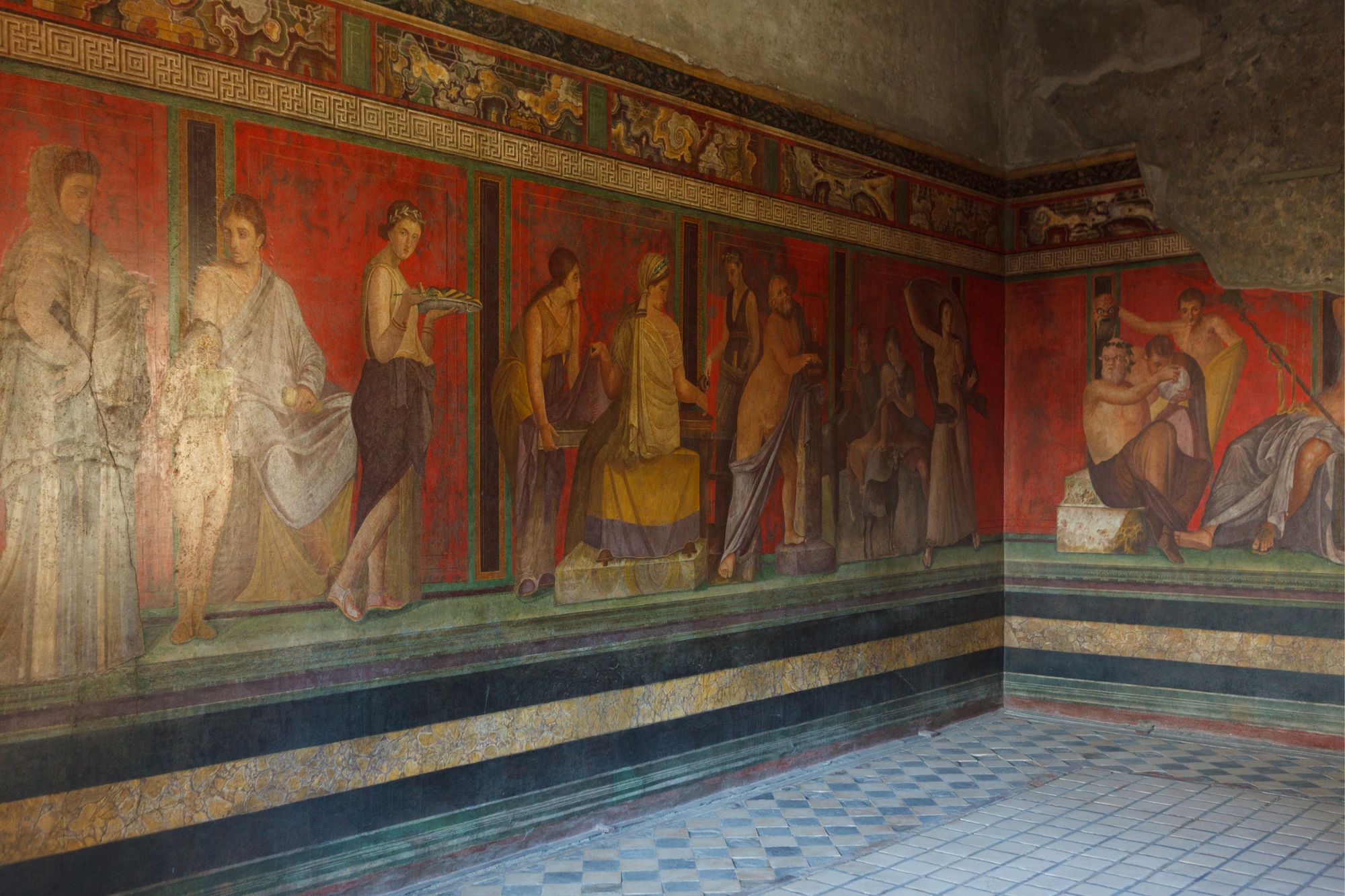
Situated slightly outside the city walls, this is absolutely worth the short walk. The vast walls of the triclinium are covered by the building’s masterpiece: the Dionysiac frieze — one of the largest and most remarkable frescoes of antiquity, depicting a mysterious female initiation rite in the cult of Dionysus.
For those who prefer the guidance of an expert, guided tours help optimise time and uncover details and stories that are easy to miss when visiting independently.
Practical tips for the day
Footwear. The ground is paved with ancient Roman cobblestones — uneven and in places quite rough. Trainers or urban hiking shoes are ideal; open sandals and smooth soles are best avoided.
Water. There is very little shade inside the site and in warmer months the sun is intense. Several public drinking fountains are dotted around the park where you can refill for free.
Sun protection. Especially in spring and summer, sunscreen, a hat and sunglasses are essential during the central hours of the day.
Luggage. Bags or backpacks exceeding 30×30×15 cm are not allowed inside the site. They must be left at the luggage deposit at the entrance gates.
Food. There are several refreshment points within the archaeological area, but you may bring a packed lunch to be consumed exclusively in the designated picnic areas.
Return times. It is important to check in advance the timetable for your return to Sorrento, so you can finish the visit without rushing.
Pompeii and other excursions from the Sorrentine Peninsula
Those who want to combine Pompeii with other sites in the same area can consult the guide to Pompeii, Herculaneum and the Campi Flegrei in one day — an itinerary designed for those based in Naples who want to combine multiple Vesuvian sites in a single packed day. For those looking for a completely different experience, Capri from Sorrento is the other great excursion that is absolutely worth planning during a stay on the Sorrentine Peninsula.
Frequently asked questions about visiting Pompeii from Sorrento
How long does it take to visit Pompeii?
For a satisfying visit that covers the main highlights without rushing, allow at least 5 or 6 hours. Those with less time can focus on the Forum, the House of the Faun, the Garden of the Fugitives and the Villa of the Mysteries, which together take around 3 hours. Guided tours help optimise the time available and ensure the most significant details are not missed.
Is it necessary to book tickets in advance?
In high season (April to October) and at weekends, online booking is strongly recommended: queues at the entrances can be very long, particularly at Porta Marina. Tickets can be purchased on the official website of the Archaeological Park of Pompeii, and guarantee priority access in a pre-assigned time slot.
What is the best time of year to visit Pompeii from Sorrento?
Spring (April to June) and autumn (September to October) are the ideal seasons: pleasant temperatures, excellent light for photography and more manageable crowds compared to summer. July and August are the busiest months, with intense heat that makes the visit more demanding. Winter offers fewer tourists and lower prices, but with reduced hours and some structures closed for restoration.
Is Pompeii suitable for children?
Yes, Pompeii is suitable for children of all ages. The casts in the Garden of the Fugitives, the Amphitheatre and the mosaics in the House of the Faun tend to captivate younger visitors. To make the visit more engaging, a family-focused guided tour is recommended — it turns the site into a story and a discovery. Comfortable shoes and plenty of water are essential, especially in summer.
How many stops are there between Sorrento and Pompeii on the Circumvesuviana?
There are approximately 10–12 stops between Sorrento and Pompei Scavi–Villa dei Misteri, depending on the line. The direct journey takes about 30 minutes with no changes. Main intermediate stations include Meta, Sant’Agnello, Piano di Sorrento, Vico Equense, Castellammare di Stabia, Gragnano and Torre Annunziata.
