


What to do in Naples when it rains: museums, historic cafés and indoor spots
Naples, as everyone knows, shows its best side under the sun. But what happens when the weather turns? No need to worry: even when the sky turns grey and outdoor strolls feel less appealing, this city still has an enormous amount to offer — places to explore, experiences to savour, surprises around every corner. In fact, a rainy day can become the perfect opportunity to discover a different side of Naples: the one made up of places and experiences that, in fine weather, tend to get pushed back to the next visit.
For anyone wondering what to do in Naples when it rains, here are some ideas for living the city to the full — without letting the weather get in the way.
Visit the museums
When it rains, museums are naturally one of the first options to consider — and Naples is not short of possibilities. For a full overview of the city’s main museums, with addresses, opening hours and practical tips, the complete guide to Naples museums is the ideal starting point. From ancient civilisations to Renaissance and contemporary masterpieces, via science, music and history, the choice is almost overwhelming.
A good first stop is the National Archaeological Museum of Naples (MANN) — one of the most important archaeological museums in the world, whose rooms house extraordinary collections spanning from prehistory to late antiquity. For art lovers, the Capodimonte Museum offers an extraordinary concentration of treasures by some of the greatest masters of all time, while the Museum of Contemporary Art Donnaregina (MADRE) holds site-specific works by artists such as Jannis Kounellis, Mimmo Paladino and Sol LeWitt.
Then there is the Sansevero Chapel Museum, home to priceless masterpieces including the Cristo Velato (Veiled Christ) by Giuseppe Sanmartino and the Pudicizia (Modesty) by Antonio Corradini. Also worth visiting: the Museum of the Treasury of San Gennaro, the Certosa and Museum of San Martino, and the National Railway Museum of Pietrarsa.
Linger in a historic café
In Naples, sheltering from bad weather can itself become a memorable experience. All it takes is stepping into one of the city’s historic cafés, ordering an espresso, and letting the atmosphere take over — period furnishings, works of art, and the scent of fresh pastries all around.
The most famous is undoubtedly Gran Caffè Gambrinus, just a few steps from Piazza del Plebiscito. Opened in 1860, it was for generations a genuine cultural salon of the city, frequented by artists, writers and public figures. Today its decorated rooms, artworks and elegant atmosphere still make it one of the most evocative stops for anyone who wants to experience the more refined side of Naples.
But Gambrinus is not the only address worth noting. The city has other unmissable historic cafés: Gran Caffè Cimmino on Via Filangieri, long the favourite haunt of the neighbourhood’s families; Caffè Ciorfito on Via San Biagio dei Librai, celebrated for both its coffee and its artisan pastries; and Gran Caffè La Caffettiera on Piazza dei Martiri, described as the first Embassy of Neapolitan coffee in Italy.
Explore hidden Naples underground
To escape the rain, you can change perspective entirely and discover what lies beneath the surface. Naples does not only live above ground: beneath its streets, buildings and even churches lies another city — silent, carved into the tuff, full of mysteries — telling more than two thousand years of history. For a complete guide to all the underground sites, with practical visiting tips, the article on underground Naples covers every stop in detail.
Napoli Sotterranea is probably the best-known site: a dense and complex network of tunnels, cavities and chambers that extends beneath the entire historic centre, between ancient traces and stories that have fed myths still alive in the Neapolitan imagination. Another particularly atmospheric experience is the Galleria Borbonica, beneath the hill of Pizzofalcone, commissioned in 1853 by Ferdinand II of Bourbon as a safe escape route for the royal family in the event of an uprising.
And then: the Catacombs of San Gennaro and San Gaudioso, the Fontanelle Cemetery, the Lapis Museum and Neapolis Sotterrata. Each is quite different from the others, but all share the possibility of making contact with a hidden and surprising dimension of the city — and of walking under cover, well away from the rain.
Discover the religious heritage
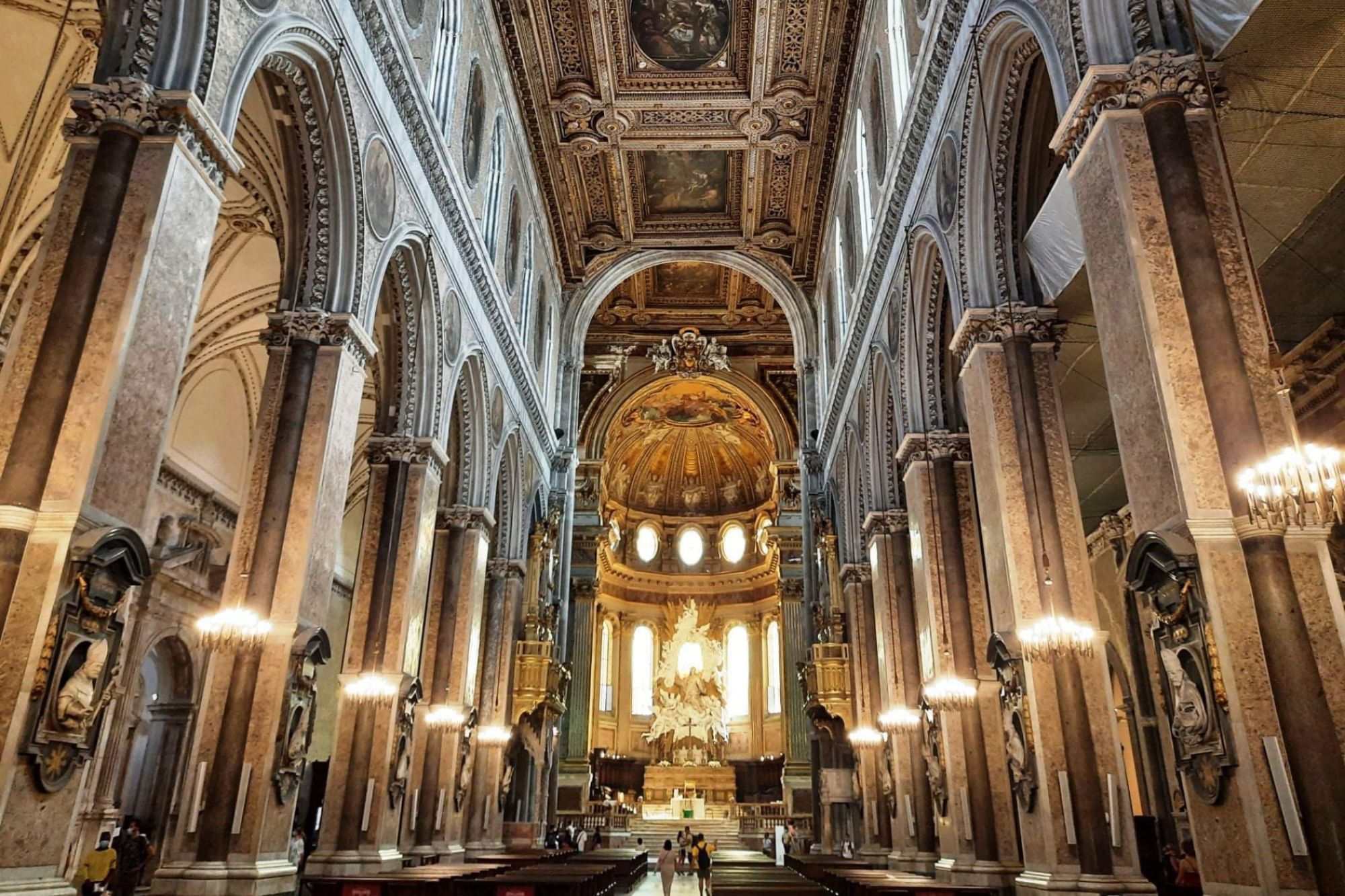
Naples is known as the “city of 500 domes” for the extraordinary concentration of churches, basilicas and religious complexes that have shaped its skyline for centuries. On a rainy day, this vast heritage becomes even more rewarding to explore — each building with its own history, its masterpieces and its quiet atmosphere.
The city’s main place of worship is the Duomo, dedicated to Santa Maria Assunta, with its famous gold mosaic and the magnificent paintings by Luca Giordano. Nearby stand the Basilica of San Domenico Maggiore, with its richly decorated chapels; the Basilica of Santa Chiara, with its beautiful cloister adorned by the vivid majolica tiles by Giuseppe and Donato Massa; and the Church of Gesù Nuovo, recognisable by its unmistakable diamond-point rusticated façade.
Other religious buildings not to miss: the Basilica of Santa Maria della Sanità, the Church of Sant’Eligio Maggiore, the Church of San Gregorio Armeno and the Church of Sant’Anna dei Lombardi. Each tells Naples from a different angle — and all of them are capable of making you forget the rain within minutes.
Experience the magic of the theatre
Among the experiences worth planning on a rainy day is a visit to the theatre, which in Naples has a centuries-old theatrical tradition and remains deeply connected to the identity of the city. As well as attending performances, it is often possible to join guided tours that allow visitors to admire historic halls and spaces not normally accessible to the public.
At the centre of this tradition stands the Teatro San Carlo — the oldest continuously active opera house in the world. Inaugurated in 1737, it was destroyed by fire in 1816 but rebuilt in the nineteenth century by Antonio Niccolini in a triumph of elegance and opulence. The programme ranges from opera and ballet to symphonic music and major concerts.
Completing the city’s theatrical landscape: the Teatro Mercadante, a historic symbol of Neapolitan culture; the Teatro San Ferdinando, inextricably linked to the figure of Eduardo De Filippo; the Teatro Bellini, a reference point in contemporary performing arts; the Teatro Trianon Viviani, known as the theatre of Neapolitan song; and the Teatro Augusteo, a temple of musical comedy.
Be surprised by the Art Stations of the Metro
This is perhaps one of the most original ideas for a rainy day in Naples: take the underground and turn every journey into a small artistic experience.
Spread along Line 1 and Line 6, the Art Stations are far more than ordinary stops — they form a genuine open-air museum of art that runs across the entire city. They represent one of the most significant and wide-ranging interventions in public architecture and art undertaken internationally over the past thirty years, involving world-renowned architects and artists who have created and exhibited over 300 site-specific installations.
The most celebrated is Toledo, designed by the Catalan architect Óscar Tusquets Blanca — awarded around the world and praised by outlets including The Daily Telegraph and CNN. Also worth lingering at: Università, Museo, Dante, Materdei and Quattro Giornate. The best thing is that no advance planning is required: just board a train and get off at whichever stations catch your eye.

Take refuge in the flavours of Neapolitan cuisine
Finally, there is the food. Because a rainy day can be the perfect excuse to slow down and give yourself all the time you need to savour the traditional dishes of this city.
The obvious first choice is pizza, enjoyed in one of the city’s many historic pizzerias. But the repertoire goes far beyond that: from pizza fritta to a cuoppo of mixed fried bites, from pasta with potatoes and smoked provola to la genovese (slow-cooked onion and beef pasta), and the slow, deep flavour of ragù. And for dessert? A sfogliatella — the flaky or the short-crust variety — or a babà alongside a proper Neapolitan coffee. After all, travelling also means allowing yourself the pleasure of eating well and discovering a place through its flavours.
Frequently asked questions about rainy-day Naples
Is Naples worth visiting even in winter or bad weather?
Absolutely. Naples has so much cultural and gastronomic life under cover that a rainy day is never wasted. In fact, museums and churches tend to be less crowded on grey days, and the atmosphere in the historic cafés becomes even more intimate and enjoyable.
Which underground site in Naples is best for a spontaneous visit?
Napoli Sotterranea, with its entrance in Piazza San Gaetano in the heart of the historic centre, is the most accessible for a walk-in visit on days of average footfall. The Catacombs of San Gennaro and the Galleria Borbonica, on the other hand, generally require advance booking — especially at weekends. The Fontanelle Cemetery is the only free, open-access site.
Are the historic cafés suitable for a quick stop?
Yes. The Neapolitan café tradition often involves a brief stop at the counter — quick, informal and very affordable. Sitting at a table or in the main room costs more, but allows you to soak up the atmosphere at leisure. At Gran Caffè Gambrinus, for example, many locals stop for an espresso at the bar and leave again immediately: it is a habit, not an exception.
Can you visit the Art Stations of the Metro without a ticket?
To access the Art Stations of Line 1 you need a standard metro ticket. There are no special passes just for the artistic visit. Those who want to work through them systematically can buy a single journey or a day ticket and stop station by station. Some stations, however, have entrance areas on street level that are accessible for free, without going through the turnstiles.
When does it rain most in Naples?
Rainfall is most frequent in autumn and winter, with November, December and January statistically among the wettest months. Spring can bring short but intense showers. Summer is the driest season. In any case, storms in Naples tend to be brief and heavy, and often give way to sunny spells within a few hours.
